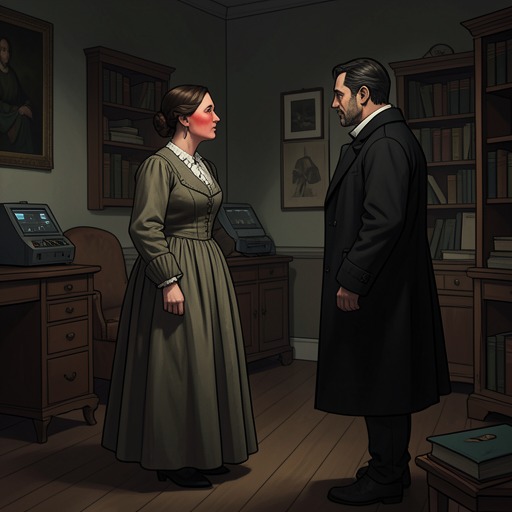
Maria Nikolaevna’s unhappy marriage
First LoveMaria Nikolaevna’s unhappy marriage to Piotr Vassilievitch shapes the emotional climate of their household and becomes a source of upheaval during the summer of 1833. Seen chiefly through the memories of their sixteen-year-old son, Vladimir Petrovitch, the marriage is marked by a mismatch of power and feeling: she is agitated and afraid of her husband, while he maintains a distant authority. When an anonymous letter brings suspicions of his intimacy with a young neighbor into their home, the strain that had largely remained private becomes impossible for Vladimir to ignore.
Marriage and household
Piotr Vassilievitch had married Maria Nikolaevna for mercenary considerations. She was ten years older than he was, and the narrator recalls her life as melancholy. Although jealousy and anger troubled her, she did not express them in her husband’s presence; she was very much afraid of him. His manner toward her was severe, cold, and distant. Vladimir remembers him as exceptionally serene, self-confident, and commanding, a portrait that emphasizes the difference between the husband’s composure and the wife’s apprehension.
Their strained relationship formed part of Vladimir’s everyday experience, even when he was not directly involved in it. He was their only child, yet his mother scarcely noticed him, absorbed by other cares; his father treated him with careless kindness. The contrast gives the marriage consequences beyond the couple themselves: the emotional distance between the parents helped leave their son with little sense of security or intimacy in the family. During the summer at the country house outside Moscow, he was largely free to follow his own pursuits, but that freedom coexisted with his awareness of his mother’s unhappiness and fear.
Money and the neighboring family
The family’s relations with the neighboring Princess Zasyekin brought financial concerns into view before the marital crisis. After the princess visited, Maria Nikolaevna complained to her husband that the visitor had wearied her with requests to intercede on the family’s behalf, and that she seemed occupied with lawsuits and financial affairs. Nevertheless, Maria invited the princess and her daughter to dinner, citing their status as neighbors and the princess’s title. Vladimir, hearing that her daughter would attend, became self-conscious, an early indication of his own emotional interest in the young woman.
Piotr Vassilievitch responded that he remembered the princess’s late husband from his youth. He recalled him as once wealthy, then financially ruined after gambling away his property and pursuing further speculations. The account placed the neighboring family’s financial difficulties beside the concerns emerging within Maria and Piotr’s marriage. Later, during the argument between the couple, Maria referred to a loan made to the old princess and spoke critically of both the princess and her daughter. The available account does not establish the loan’s terms or explain its place in the marriage, but it shows that money, the neighbors, and suspicion of infidelity converged in the dispute.
The letter and marital confrontation
The immediate cause of the confrontation was an anonymous letter. Vladimir did not witness the argument between his parents: after returning from a walk, he learned from the young waiter Philip that a serious scene had taken place and that servants had overheard it. Philip reported that Maria had accused Piotr of infidelity and of an intimacy with the young woman next door. Piotr initially defended himself, then lost his temper and made a cruel remark about Maria’s age, which caused her to cry. According to Philip, she also raised the loan to the princess and criticized the neighboring women; Piotr threatened her.
The information reached Vladimir by way of household staff rather than either parent. Philip said that the letter had brought the matter to light and that its author was unknown. He also implied that there had been grounds for Maria’s suspicions, pointing to the practical difficulty of keeping a relationship secret when a carriage and servants were involved. This remained secondhand testimony, but it changed Vladimir’s understanding: he had already been troubled by his feelings for the young neighbor, and now learned that his father’s connection to her was not merely an object of his imagination. The revelation stunned him, while leaving him without a direct explanation from either parent.
Aftermath and significance
The next day Maria announced that she would return to Moscow. Piotr went into her bedroom and remained there alone with her for a long time; no one overheard what he said. Afterward she no longer wept and asked for food, but she did not appear in public or alter her decision to leave. The account records this shift in her visible distress without explaining what passed between the couple, preserving the privacy of their reconciliation or discussion rather than claiming that the underlying conflict was resolved.
That evening Piotr led Count Malevsky through the dining room into the hall and ordered him not to visit again, threatening to throw him out if he returned. In the presence of a footman, Piotr also referred coldly to the count’s handwriting. The scene followed the discovery of the anonymous letter, but the narrative does not establish that Malevsky wrote it. The family’s preparations to move to their house on Arbaty Street proceeded quietly. Vladimir understood that his father had probably persuaded his mother against making a public scandal; Maria even sent her compliments to the old princess and expressed regret that illness prevented her from meeting again before the departure.
For Vladimir, the marriage crisis also sharpened questions about the young neighbor’s choices. He wondered how she could become involved with a man who was not free to marry her, when she might have married someone such as Byelovzorov, and what she expected or feared for her future. These are the son’s unanswered questions, not an explanation of her motives. The marriage is therefore depicted both as Maria’s painful domestic reality and as the event that abruptly alters Vladimir’s understanding of his parents, his father, and the object of his first love.